Hiring Sales Development Representatives (SDRs) is often constrained by a narrow definition of “qualified”, typically, candidates with prior sales experience. But this approach doesn’t just limit your talent pool. It actively filters out the people most likely to perform.
Josh English, former Head of Sales Development at Salesforce, built some of his highest-performing SDR teams by ignoring that filter entirely:
“The best SDRs don’t always come from sales backgrounds. They come from people who know how to think, adapt, and connect. I’ve hired a comedian, a pilot — completely different profiles — and they’ve thrived. That’s when you realise: experience isn’t the predictor, mindset is.”
At UltraTalent, we’ve placed SDRs across SaaS companies at every stage and seen this play out consistently. The candidates who look most qualified on paper, prior outbound experience, the right tool stack, quota numbers on the CV, are not necessarily the ones who perform.
The ones who do share something harder to spot in a job application: how they think under pressure, how fast they adapt, and whether they have the instinct to connect with a cold prospect in the first five seconds of a call.
This guide covers how to hire SDRs using that lens — the criteria, the screening process, what to pay, and how to onboard for a fast ramp.
Should I Hire SDRs or Invest in AI Automation?
This is the question we are hearing a lot from founders and sales leaders hiring SDRs. With AI SDR tools promising to automate outbound at a fraction of the cost, it is very normal to have this question in mind.
Here is what the data actually shows.
The AI SDR category attracted significant venture capital between 2023 and 2025. 11x — backed by $74M from Andreessen Horowitz and Benchmark — became the poster child.
ZoomInfo ran a one-month trial and found that 11x “performed significantly worse than their SDR employees.” They didn’t renew. 11x continued listing ZoomInfo as a customer in sales calls for months.
The company ultimately lost 70–80% of its customers. Industry-wide, 50–70% of AI SDR tools churn within their first year.
The performance gap is measurable. AI SDRs generate reply rates of 3–8% on cold outreach. Human SDRs generate 5–12%. In a direct comparison of complex B2B deals, human SDRs generated 2.6x more revenue and a 71% meeting show rate, compared with AI’s 52%.
Where AI genuinely wins?
Inbound lead qualification and high-volume top-of-funnel sequences where speed matters more than nuance.
Greenhouse moved chat-to-meeting conversion from 20% to 50–70% using AI on inbound. Response time inside 5 minutes versus 30 minutes increases conversion by up to 100x — and AI wins that race every time.
Where are human SDRs irreplaceable?
Complex B2B outbound, strategic accounts, multi-threaded deals, and any scenario where a prospect’s objection requires real-time judgment. These are exactly the scenarios most SaaS companies are running.
The right answer for most SaaS teams
Hire the SDR, arm them with AI tools. Use platforms to automate list-building, account research, and trigger monitoring.
Use a sequencer for follow-up cadences. Let your SDR focus on the calls, replies, and conversations that require a human touch. That combination, a skilled SDR with an AI-augmented workflow, consistently outperforms either approach on its own.
If your deal cycle is short, your ICP is broad, and your outreach is high-volume with low personalization requirements, AI tooling may cover more ground than a junior hire.
But if you’re selling a product with a 30–90 day sales cycle, multiple stakeholders, and a meaningful ACV, you need a human in that seat.
When is the Right Time to Hire SDRs?
Before you post a job listing, confirm you’re ready. Hiring SDRs into a broken system leads to churn and wasted spend. You’re ready when:
- You have a proven ICP and repeatable sales motion — SDRs need a playbook, not a blank canvas.
- You have a working outbound tech stack — CRM, sequencer, and a data source.
- An AE or sales leader has quota capacity to run discovery calls. There’s no point booking meetings if no one can take them.
- You can commit to onboarding — SDRs need 30–60 days of structured ramp before they’re productive.
- Your LTV: CAC ratio supports the hire — SDR-sourced pipeline should close at rates that justify base + commission + tooling costs.
If you’re pre-product-market fit, consider a full-cycle seller who can prospect and close. SDRs thrive in scaled, repeatable environments.
If you want to know how your sales team structure should look according to your growth stage, read our blog on SaaS Sales Team Structure.
What to Look For When Hiring SDRs
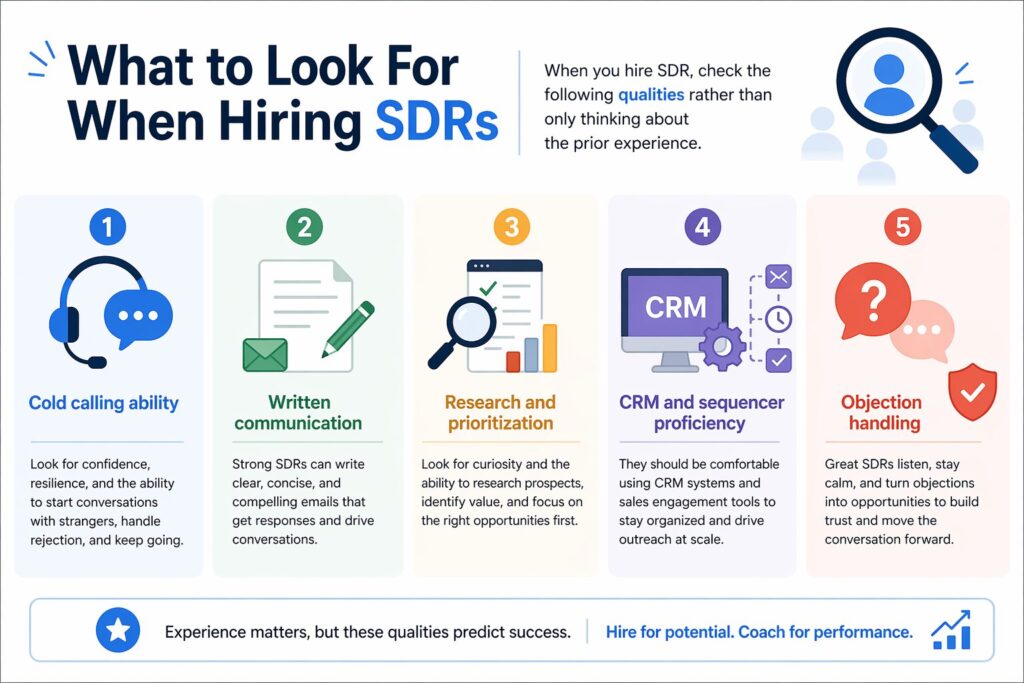
When you hire SDR, check the following qualities rather than only thinking about the prior experience.
1. Cold calling ability
The phone typically produces the highest conversation-to-meeting conversion in outbound. Ask candidates to do a live cold call mock during the interview. You’ll immediately separate the talkers from the doers.
2. Written communication
Email personalization and LinkedIn messaging drive replies. Ask to see examples of outbound sequences they’ve written or have them draft one on the spot.
3. Research and prioritization
Top SDRs don’t spray and pray. They research accounts, identify triggers (funding, hiring sprees, new leadership), and personalize outreach at scale using tools like Clay or Apollo.
4. CRM and sequencer proficiency
Familiarity with Salesforce, HubSpot, Outreach, or Salesloft means a faster ramp. Comfort with some CRM is essential; exact stack match isn’t a dealbreaker.
5. Objection handling
Test this directly. Give them a common objection (“We already have a vendor,” “Send me an email,” “We’re not looking right now”) and watch how they respond.
The MAGIC Framework: Evaluating Raw SDR Talent
Most SDR hiring decisions overweight prior experience — title, company name, meetings booked — and underweight the traits that predict whether someone will actually outperform.
Most hiring panels end up validating assumptions rather than discovering talent. Referral-heavy loops create homogeneous teams. Experience on paper screens out candidates who haven’t had the right opportunities yet.
The MAGIC framework is a scorecard for raw SDR potential:
M — Multiplier
Does this person raise the performance of the people around them — not just hit their own number? Candidates from non-traditional backgrounds (retail managers, former athletes, teachers) often bring perspectives that shift team dynamics upward. Look for people whose presence changes how others operate.
A — AI-Ready
SDRs live in tooling. A candidate who hasn’t engaged with AI in their outbound workflow will fall behind. Test it directly: “Walk me through how you’ve used AI or automation in your prospecting process.” Fluency here predicts tool adoption broadly.
G — Growth Mindset
The best SDRs treat feedback as data, not criticism. Ask: “Tell me about a time someone significantly changed your perspective on how to approach your work.” Candidates who can’t name a specific example often can’t iterate quickly under coaching.
I — Innovator
Ask: “What did you do in the last role that wasn’t required of you, but helped your team?” SDRs who improve systems — building a better prospect list, writing a sequence the whole team adopts — generate value beyond their own quota.
C — Courageous Communicator
Outbound sales is not compliance work. SDRs need to push back on brush-offs, respectfully challenge prospects, and flag internally when a sequence isn’t working. Look for candidates who’ve disagreed with a manager or process and can describe how they handled it constructively.
One concrete signal: track the number of substantive questions a candidate asks across your interview stages. Curiosity in the interview room predicts curiosity on the phone.
SDR Hire: Green Flags vs. Red Flags
| Green Flags | Red Flags |
|---|---|
| Has specific metrics from prior roles (X meetings/month, Y reply rate) | Vague about past performance |
| Asks about your ICP, tech stack, and sales process | Only asks about comp and remote policy |
| Has done their homework on your company | Generic answers that could apply to any company |
| References specific objection-handling techniques | Says “I’m a people person” as their #1 SDR trait |
| Can articulate their daily outbound workflow in detail | Has never cold called |
| Demonstrates coachability with a specific example | Gets defensive when pushed on mock call performance |
| Has used or experimented with AI tools in their workflow | Has no awareness of AI tools relevant to outbound |
| Asks questions that reveal real thinking about your ICP | Rehearsed answers about KPIs only |
How to Write an SDR Job Posting That Attracts Top Candidates
Your job posting competes with every other SDR role on LinkedIn. Make it specific and honest.
SDR Job Posting Structure:
Title: Use common search terms. “Sales Development Representative (SDR)” outperforms creative titles like “Pipeline Ninja” or “Outbound Rockstar” in organic search.
Opening hook (2–3 sentences): Lead with what makes this role worth their time — commission upside, clear AE path, strong deal flow.
What you’ll do (bullet list):
- Prospect and identify target accounts within our ICP
- Execute high-volume outbound via cold calls, email, and LinkedIn
- Book qualified discovery meetings for Account Executives
- Maintain clean CRM activity logs in [tool]
- Collaborate with marketing on targeted campaigns
What we’re looking for:
- Be specific about experience level (1–3 years outbound preferred vs. open to entry-level)
- List required tools only if non-negotiable
- Emphasize mindset traits over checkbox skills
What we offer (be transparent):
- Base salary range (job listings that include salary receive 30% more applications, per LinkedIn data)
- OTE and commission structure
- Remote/hybrid policy
- Ramp period and training program
- Promotion path (SDR → Sr. SDR → AE timeline)
The promotion path matters more than most hiring managers realize. High-performing SDRs are already thinking about their next role. A defined AE path is one of the strongest retention signals you can include.
Where to Hire SDRs: Best Platforms and Channels
Work with Specialist SaaS Sales Recruiters
Most SDR hiring channels, like LinkedIn, job boards, and referrals, only reach candidates who are actively looking.
The top 1% of SDRs are rarely on the market. They’re hitting quota, building pipeline, and not refreshing their inbox for recruiter messages. Accessing that talent requires a network, not a job posting.
UltraTalent is a GTM recruiting partner built specifically for SaaS companies. The difference starts with who does the vetting: UltraTalent’s recruiters have carried their own quota.
They’ve run outbound, managed pipelines, and closed deals, which means they assess SDR candidates the way a sales leader would, not the way a generalist recruiter would. They’re evaluating cold calling instinct, objection handling under pressure, and outbound judgment not just scanning for the right tool stack on a CV.
Every candidate in UltraTalent’s pipeline is drawn from a 25,000+ GTM talent network. The shortlist you receive has already been screened for execution ability — cold outreach quality, CRM proficiency, and the MAGIC framework criteria that predict outperformance. You’re not filtering noise. You’re choosing from a small group of people who’ve already been tested.
For a SaaS company where an open SDR seat costs pipeline every week it remains unfilled, the combination of passive talent access, sales-practitioner vetting, and speed to shortlist makes specialist hiring worth it.
The default channel for most companies. LinkedIn Recruiter lets you filter by title, tools used, and industry experience. Effective but expensive — you’re competing for the same candidates as everyone else.
Indeed and Glassdoor
High-volume inbound. Best for entry-level and junior SDR roles where you want a large applicant pool to screen. Lower signal-to-noise ratio than LinkedIn.
Apollo.io and ZoomInfo (direct sourcing)
Build your own pipeline. Use Apollo or ZoomInfo to identify SDRs at competitor companies or strong sales orgs, then reach out directly. Works if you have a recruiter or sourcer with capacity.
Niche Sales Communities
- RevGenius — 40,000+ revenue professionals on Slack
- Pavilion (formerly Revenue Collective) — senior sales talent, peer network
- SDR Nation — community specifically for SDRs, useful for direct outreach to motivated candidates
- Bravado — sales-specific career platform
The SDR Interview Process: How to Hire Top-Performing SDRs
A structured interview process is the single biggest variable in whether you make a good SDR hire. Most companies over-rely on gut feel or run a generic loop that doesn’t test SDR skills. Here’s a process that works:
Stage 1: Recruiter Screen (30 min)
Assess basic fit: motivations, timeline, comp expectations, remote/in-office preference. Ask for specific metrics from their current or most recent role. Advance candidates who can give you actual numbers.
Stage 2: Hiring Manager Interview (45 min)
Go deep on their outbound process: How do they build lists? What does their daily cadence look like? How do they personalize at scale? Ask about a prospect they struggled to reach and what they did about it.
Design your questions for discovery, not validation. If a question can be answered with rehearsed KPIs, you’re not learning how the candidate actually thinks. Open-ended questions that require real examples reveal far more.
Stage 3: Skills Assessment (Async, 48 hours)
Send a take-home task:
- Write a 3-step outbound sequence for a realistic prospect at your ICP
- Research a target account and write a personalized first email
- Record a 60-second cold call voicemail
This filters for effort, writing quality, and product curiosity. Candidates who half-ass the assessment will half-ass prospecting.
Stage 4: Live Mock Cold Call (30 min)
This is the make-or-break stage. Give them a realistic scenario and roleplay as a skeptical prospect. Watch for:
- Do they open with a strong hook or a rambling intro?
- Do they listen and adapt, or recite a script?
- How do they handle “I’m not interested”?
- Do they try to schedule the next step even on a tough call?
You’re not expecting perfection — you’re assessing coachability, composure, and raw instincts.
Stage 5: Reference Checks
Call their manager, not just the references they provide. Ask specifically: “Would you rehire them? Why or why not? Where did they rank on the team? What would they need to work on to move to AE?” You’ll learn more in 10 minutes than in a 45-minute interview.
SDR Compensation Benchmarks in 2026
| Level | Base Salary | OTE | Quota (Meetings/Month) |
|---|---|---|---|
| Entry-Level SDR (0–1 yr) | $45,000–$55,000 | $60,000–$75,000 | 10–15 |
| Mid-Level SDR (1–3 yr) | $55,000–$70,000 | $80,000–$100,000 | 15–25 |
| Senior SDR / Lead SDR | $70,000–$85,000 | $100,000–$130,000 | 20–30 |
| Remote / LATAM SDR | $25,000–$45,000 | $35,000–$60,000 | 10–20 |
Key comp principles:
- Keep variable at 25–40% of OTE — enough to motivate, not so much that base feels insufficient.
- Pay on qualified meetings held, not just meetings booked. This aligns SDR incentives with AE outcomes.
- Accelerators matter — top SDRs should be able to earn 120–150% of OTE. Without them, you’ll lose your best performers.
- Equity is increasingly expected — even at the SDR level. Small grants signal long-term investment in the hire.
Also Read: 75 Motivational Quotes for Sales Teams
How to Onboard and Train SDRs for Success
The goal of SDR onboarding is to get them to their first booked meeting as fast as possible — ideally within 30 days.
Week 1: Foundation
- Product deep-dive: what you sell, who buys it, and why
- ICP workshop: firmographics, personas, pain points, trigger events
- Tech stack setup: CRM, sequencer, data tool, LinkedIn Sales Navigator
- Listen to 10–15 recorded discovery calls and closed/won deals
Week 2: Process and Messaging
- Walk through the existing sequence library and playbooks
- Review best-performing email templates and call scripts
- Have them write their own versions and get feedback
- Shadow top SDRs for live calls and sequencing sessions
Week 3: Ramp with Guardrails
- Begin prospecting under supervision — review lists before they send sequences
- Run daily 15-minute call coaching sessions
- Set soft targets: 5 connects, 3 positive conversations, 1 meeting booked
Week 4+: Full Ramp
- Increase to full quota expectation by Day 60–90
- Weekly 1:1s reviewing activity metrics, conversion rates, and pipeline quality
- Monthly listen-in on discovery calls to close the feedback loop
Giving reps too much autonomy too early is the most common onboarding failure. Structure protects both the rep’s ramp confidence and your pipeline quality.
Common Mistakes When Hiring SDRs
1. Hiring for personality over process
“Great energy” doesn’t equal great prospecting. Always test skills directly.
2. Skipping the mock cold call
If you don’t hear them on the phone before you hire them, you’re flying blind on their most critical skill.
3. Setting unrealistic quotas too fast
Ramp quotas exist for a reason. Full quota in week one destroys confidence and distorts your performance data.
4. Neglecting manager-to-SDR ratios
One SDR manager should oversee no more than 6–8 reps. Beyond that, coaching quality degrades and performance drops.
5. Treating the SDR role as a revolving door
Without a defined AE promotion path, your best SDRs will leave for companies that have one — typically within 12 months.
6. Hiring on referrals alone
Referral-heavy hiring creates homogeneous teams. The strongest SDR you hire might not have a traditional sales background — they might be a former teacher, athlete, or retail manager who learned to read people before they ever picked up a phone. Diverse sourcing is not an HR initiative; it’s a competitive advantage.
7. Ignoring the tech stack in the hiring process
Hiring an SDR without good data tools (Apollo, ZoomInfo, Clay) and a sequencer sets them up to underperform regardless of their skill level. The tools are part of the output.
8. Trying to manage your way out of underperformance
SDR tenure averages under 18 months industry-wide. Some churn is structural — not every hire will work regardless of how much coaching you invest. The managers who build consistently high-performing SDR teams don’t over-invest in rescuing poor performers. They set clear 30/60/90-day ramp benchmarks, provide structured coaching within that window, and move on quickly when reps aren’t responding.
Holding onto a low performer out of optimism blocks quota, demoralizes the rest of the team, and delays the pipeline you needed three months ago. Keep the team lean. Replace decisively. The goal is a high-performing SDR function — not a full headcount.
Frequently Asked Questions About Hiring SDRs
What does SDR stand for?
SDR stands for Sales Development Representative. An SDR is responsible for outbound prospecting — identifying potential customers, reaching out via cold calls, email, and LinkedIn, and booking qualified discovery meetings for Account Executives.
How do I hire top-performing SDRs?
Use a structured, skills-based interview process that includes a live mock cold call and a written skills assessment. Test what SDRs actually do — cold outreach and objection handling — rather than relying on gut feel or general interviews.
What is the best way to hire SDRs for my team?
Define your ICP and outbound process first, then source from multiple channels: LinkedIn, niche sales communities like RevGenius or SDR Nation, and pre-vetted talent platforms. A structured 4–5 stage interview process with a mock cold call will improve hire quality.
Which platforms help hire SDRs and BDRs?
LinkedIn Recruiter, Indeed, Apollo.io for direct sourcing, and niche communities like RevGenius, Bravado, and SDR Nation. Pre-vetted talent platforms offer faster time-to-hire with lower screening risk.
How long does it take an SDR to ramp?
Most SDRs reach full productivity within 60–90 days with a structured onboarding program. Expect 30 days before their first meeting booked and 60–90 days before they’re consistently hitting quota.
Should I hire remote SDRs?
Yes — remote SDRs can perform well, particularly when hired into a structured onboarding program with daily check-ins and a clear playbook. Many US companies are hiring SDRs from Latin America to cover US time zones at a lower base salary.
How much does it cost to hire an SDR?
US-based SDRs typically have a base salary of $45,000–$70,000 with an OTE of $65,000–$100,000. Remote/LATAM SDRs typically cost $25,000–$45,000 base. Add tooling costs ($3,000–$8,000/year per SDR for CRM, sequencer, and data tools) and recruiter fees if applicable.
What’s the difference between an SDR and a BDR?
The terms are often used interchangeably. In some organizations, SDRs focus exclusively on outbound while BDRs handle inbound lead qualification. The distinction varies by company.
Conclusion
Hiring SDRs is one of the highest-leverage investments a sales team can make — and one of the easiest to get wrong. The companies that build top-performing SDR teams share a few traits: a structured interview process with real skills tests, a disciplined onboarding program, clear career progression, and the right tooling.
Most mis-hires come from hiring on familiarity — referrals, prior titles, confident interview presence — rather than assessing the actual skills and mindset the role demands. Use a structured process. Test cold outreach directly. Evaluate raw potential using a framework like MAGIC, not just experience on paper.
Whether you’re hiring your first SDR or your tenth, the principles are the same: be specific about what you need, test what actually matters, and invest in making them successful once they join.
If you want to skip the sourcing and vetting process, UltraTalent connects you with pre-vetted SDRs — including talent from Latin America — who are ready to prospect on day one.