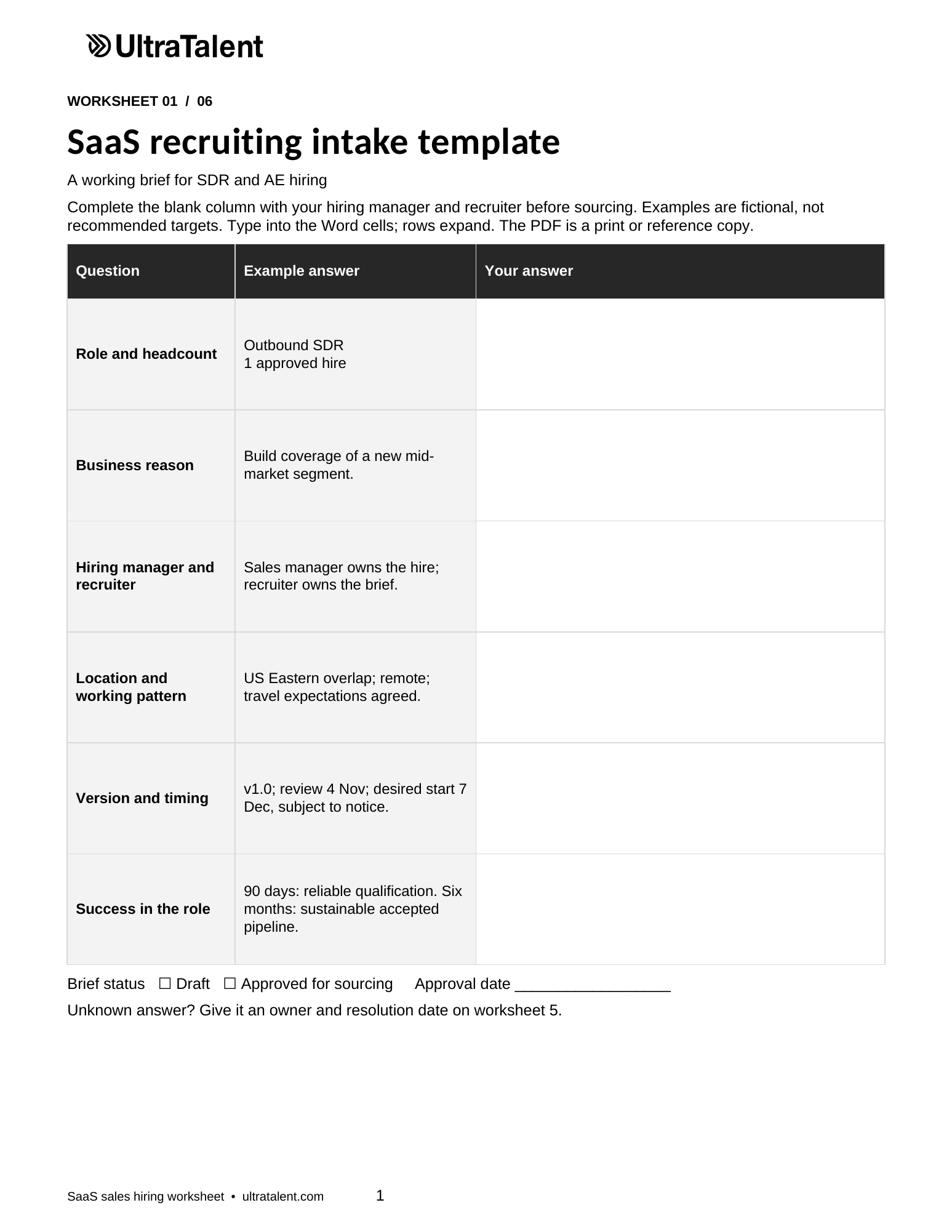
A recruiting intake form is a brief that the hiring manager and recruiter agree on before sourcing candidates. For SaaS SDR and AE roles, it should define the sales motion, success measures, compensation, candidate evidence, and hiring decisions. It also needs to explain what the hire will inherit, build, and depend on.
Consider two illustrative candidates with five years of SaaS sales experience. One closes $15,000 contracts with small businesses through inbound enquiries. The other creates $150,000 enterprise opportunities and coordinates technical, financial and procurement stakeholders. The values illustrate different selling conditions; they are not market benchmarks.
A useful intake form makes those differences visible before the first shortlist. This guide explains what to include, how SDR and AE requirements differ, and how to turn the brief into a practical search.
What should a SaaS recruiting intake form include?
Start with these eight sections:
- Business reason and search ownership.
- Customers, sales motion and role boundaries.
- Targets, ramp and available support.
- Compensation and working arrangements.
- Candidate requirements and assessment evidence.
- Reasons a suitable candidate would join.
- Interview stages and decision rights.
- Sourcing plan, approvals and review dates.
Complete a core form for each role, adding the relevant SDR or AE fields. A shared template works well when the answers reflect each assignment. Keep the fuller working document separate from the candidate-facing job description.
1. Explain why the hire is needed
Begin with the business problem. “We need another SDR” leaves the recruiter guessing about the work.
A clearer brief might say: “Inbound enquiries wait several days for qualification, and AEs are spending too much time screening them.” An outbound role would need a different explanation, account list and assessment.
Record:
- Whether this is a replacement, team expansion or a new sales motion.
- The hiring manager, reporting line and person maintaining the brief.
- Approved headcount and any remaining approvals.
- The intended start date and relevant constraints.
- What successful performance should look like during onboarding and after ramp.
Ask what happens if the role remains vacant. That conversation helps the team weigh search speed, required experience and available support. For an expansion hire, use sales capacity planning to test whether the gap calls for another seller or different support.
2. Describe the sales motion and role boundaries
Sales motion means how the company finds, qualifies and wins customers. Describe the actual work rather than relying on labels such as “enterprise” or “full-cycle”.
Capture the customer segment, buyer, typical contract value and sales cycle. Add the stakeholders involved, including technical evaluation, procurement and commercial approval.
Explain where opportunities come from. An AE receiving qualified meetings needs a different brief from one expected to build most of their pipeline.
Use three questions to clarify ownership:
What will they inherit? List existing accounts, opportunities, customer evidence, sales messages and systems. Explain which resources are ready to use.
What must they build? Identify new relationships, outbound messages, account research or processes they will create. Separate these responsibilities from work owned by marketing or management.
Who will they depend on? Name the colleagues providing coaching, technical support, lead generation and commercial approvals. State what support is available.
Brett Stephenson discusses working with limited direction and collaborating across teams in From Startup to Scaleup. Your brief should make the expected independence and team support equally clear.
Finally, define where ownership ends. For an SDR, this might be an accepted opportunity with agreed qualification notes. For an AE, it might include contracting and a documented handoff to customer success.
3. Agree targets, ramp and support
Targets help candidates understand the opportunity. They also help the recruiter distinguish relevant experience from a familiar job title.
For an AE, record:
- Quota, measurement period and whether it covers new revenue, bookings or expansion.
- Ramp expectations and how targets change during onboarding.
- Current team attainment and the period reviewed.
- Available pipeline and the prospecting the AE will own.
- Territory assumptions, sales-engineering support and deal-coaching capacity.
For an SDR, record:
- Whether success means meetings held, accepted opportunities or qualified pipeline.
- The definition of a qualified opportunity and who accepts it.
- Inbound and outbound responsibilities.
- Ramp expectations, coaching and account coverage.
Use company evidence when setting targets. If the founder has closed only a few deals, label the resulting assumptions clearly. A new seller may have different access, credibility and support.
Weak team attainment should prompt questions about pipeline, territory and execution. Record the issues the team is investigating so candidates receive a realistic picture.
Use our sales quota definition checklist to agree the target, crediting rules and ramp expectations before briefing candidates.
4. Explain compensation beyond OTE
An on-target earnings (OTE) figure needs a supporting explanation. Candidates will want to know how the base and variable components work.
Include the approved range and currency, commission triggers, payment timing, accelerators, caps and clawbacks. Record any ramp guarantee or recoverable draw and identify who can explain the plan.
For SDRs, distinguish payment for meetings booked from payment for meetings held or opportunities accepted. For AEs, explain which revenue counts and how credit is shared.
Keep the employment location, remote policy, travel and territory coverage alongside the compensation details. These terms affect which candidates can realistically accept the role.
Resolve material pay and headcount approvals before presenting the opportunity. Record approval owners for exceptions rather than promising flexibility the recruiter cannot offer.
5. Turn candidate requirements into evidence
Separate essential capabilities from preferences and skills the team can teach. For every essential requirement, explain why the role needs it and how you will assess it.
For example:
| Vague requirement | More useful evidence to request |
|---|---|
| Enterprise sales experience | A deal involving several stakeholders, with the candidate’s contribution and buying process explained |
| Strong prospecting skills | An opportunity the candidate created, including account selection, outreach and progression |
| Excellent communication | A clear outreach message or accurate handoff note using a fictional brief |
| Coachability | How the candidate applies specific feedback during a relevant exercise |
Avoid choosing arbitrary thresholds simply because they are easy to screen. A particular deal value or pipeline percentage should reflect the assignment and available evidence.
Give each interviewer a defined area to assess. Agree what strong, acceptable and weak evidence looks like before comparing candidates.
For an SDR, the sales hiring assessment shows how to evaluate practical work. For an AE, connect deal evidence to an account executive interview scorecard.
6. Give candidates a credible reason to join
The recruiter needs a specific answer to “Why this role?” Include the territory opportunity, manager’s coaching approach, onboarding support and scope for development.
Where progression matters, describe the criteria and available evidence. A promotion pathway is more credible when the team can explain how readiness is assessed.
Be equally clear about work still being built. Candidates considering an early-stage role need to understand the resources available and the decisions they will help shape.
Record only benefits, resources and opportunities the company can substantiate. This gives the recruiter a consistent pitch throughout the search.
7. Set the interview process and decision rights
Agree the purpose of each stage, the interviewer and the evidence they must collect. Keep the process proportionate to the role.
An SDR process might combine a recruiter conversation with a manager interview and short practical exercise. A complex AE search may require additional technical or leadership input.
Confirm who makes the final decision, who approves compensation exceptions and when feedback is due. Set a realistic turnaround the interviewers can meet.
If the founder must meet every finalist, include that stage from the beginning. Late additions create uncertainty for candidates and complicate scheduling.
8. Agree the sourcing plan and review points
Ask the recruiter to propose relevant backgrounds, adjacent job titles and sourcing routes. Discuss internal applicants and referrals alongside external search.
Use sample profiles early to test whether everyone interprets the brief consistently. Three contrasting profiles can make the trade-offs easier to discuss: a close match, an adjacent background and a candidate with a clear development gap.
Record what changes after that discussion. Keep one dated version of the brief so candidates are assessed against the same requirements.
Repeated rejections for the same unexpected reason should trigger a review. Check whether the requirement was missing, the evidence was poorly defined or the market differs from the initial assumption.
How should SDR and AE intake questions differ?
The core decisions stay consistent, while the evidence changes with responsibility and seniority. Early-career SDR searches may allow more transferable experience. AEs responsible for complex sales need relevant evidence of managing those deals.
| Intake decision | SDR emphasis | AE emphasis |
|---|---|---|
| Success measure | Qualification quality, meetings held or accepted opportunities | Bookings, new revenue or expansion, with clear crediting rules |
| Sales experience | Research, outreach, listening and learning | Discovery, opportunity management, negotiation and closing |
| Pipeline ownership | Inbound qualification or outbound account coverage | Inherited opportunities and expected self-sourcing |
| Support | Day-to-day coaching and AE feedback | Technical support, deal coaching and commercial approvals |
| Practical assessment | Account prioritisation, cold call or outbound email | Discovery exercise or structured deal review |
| Progression | Development opportunities and criteria | Territory, segment, leadership or specialist opportunities |
Two questions are especially useful when adapting the form:
For an SDR: “What could a career switcher demonstrate that would earn an interview?” This helps the team consider transferable evidence while preserving the job’s essential requirements.
For an AE: “Is the company changing how it sells?” A move upmarket or away from founder-led referrals may require capabilities the current team has had little reason to develop.
If you are hiring your first account executive, document the founder’s continuing role in complex deals and approvals.
Example of a completed SDR intake brief
This fictional example shows the level of detail to aim for. It represents no actual UltraTalent client.
| Field | Example answer |
|---|---|
| Business need | Build outbound coverage for customer-onboarding software while the AE handles discovery and closing |
| Buyer | Customer success leaders at SaaS businesses with recurring onboarding coordination problems |
| Inherits | Initial account list, CRM access, approved product material and relevant customer examples |
| Builds | Account research, tailored first-contact messages and accurate qualification notes |
| Depends on | Sales manager for two weekly coaching sessions during onboarding; AE for documented opportunity feedback |
| Handoff | An account in the target segment, an identified problem and an agreed next conversation, recorded for AE review |
| Essential evidence | Clear writing, structured research, useful questions and application of feedback |
| Assessment | A fictional account-prioritisation task, outbound email and discussion of the candidate’s reasoning |
| Open decision | Sales manager to confirm account exclusions and target assumptions before sourcing begins |
The complete brief would also include approved pay, working arrangements, interview ownership and review dates. Those terms belong to the employer’s actual hiring plan.
How to run the intake meeting
Allow enough time to resolve the main decisions together. A 45–60 minute session is a useful starting point for a focused role.
Before the meeting, ask the manager to bring the headcount approval, compensation range and recent sales evidence. The recruiter should prepare questions and an initial view of relevant candidate backgrounds.
During the meeting, complete the form on screen. Challenge unclear requirements with examples and distinguish agreed facts from assumptions.
Before closing, give each unresolved question an owner and resolution date. Decide which gaps block sourcing and which can be tested through early market feedback.
Frequently asked questions
Who owns the recruiting intake form?
The hiring manager owns the role requirements and approves the brief. The recruiter maintains the working version and coordinates changes. Finance, revenue operations and other stakeholders contribute where they own targets, compensation or resources.
How is an intake form different from a job description?
The intake form records the internal decisions behind the search, including assessment evidence, approvals and open questions. The job description communicates the role to candidates. Write it from the agreed intake brief.
Can the same form cover several hires?
Yes, when responsibilities and selling conditions are genuinely the same. Create separate versions when territory, seniority, support, customer segment or sales motion changes the assignment.
What if the sales targets are still uncertain?
Record the evidence available, the assumptions and who will validate them. Resolve uncertainty that materially changes compensation or responsibilities before asking candidates to evaluate the role.
Get the recruiting intake template
The recruiting intake template brings together the role brief, SDR and AE questions, assessment evidence, approvals and review dates. The request form asks for your Name, Work email and Designation.